The AI tool ecosystem is growing fast. AI agents can now browse the web, write and run code, send emails, query databases, trigger multi-step workflows, and more. However, most of these tasks require MCP to connect the AI model to specific tools.
If you've heard about MCP but haven't tried it yet, and you're wondering if it's just another word for API, this article will clear things up. We'll break down what API and MCP actually are, how they differ, and how they work together.
What Is an API?
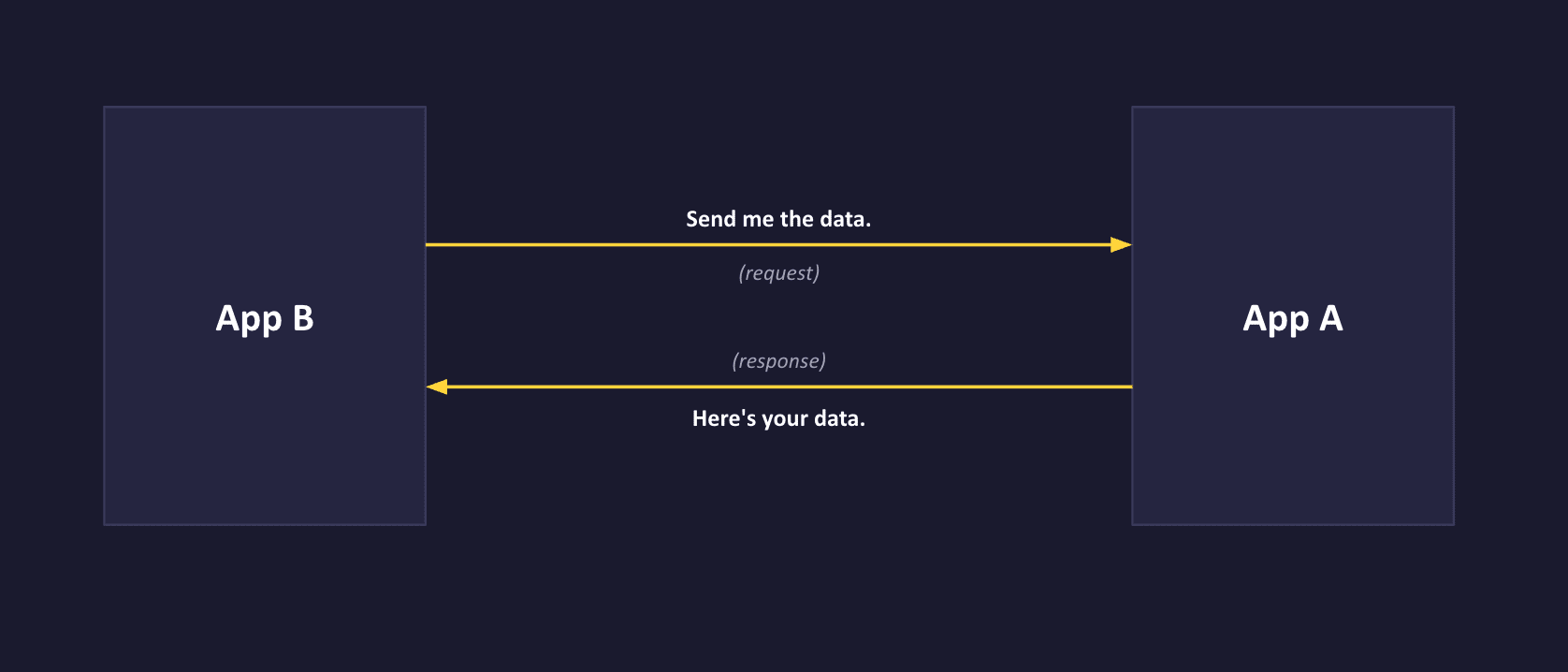
An API (Application Programming Interface) acts as a middleman between different applications to allow communication and data exchange between them. It allows one application to interact with another without exposing the internal details of either system.
Common types include REST, GraphQL, and gRPC, and the methods for requesting and sending data are clearly defined. For example, if you want to get the current time from a time API, you would use a specific request method like GET /current-time. The API then responds with the requested data in formats like JSON or XML.
What Is MCP?
MCP (Model Context Protocol) is an open standard introduced by Anthropic to enable developers to build secure, two-way connections between their data sources and AI-powered tools (like an API for AI tools).
MCP has three core components:
- MCP Hosts: The AI-powered applications that need access to external data (like Claude Desktop or an AI coding assistant).
- MCP Clients: They maintain dedicated connections with MCP servers.
- MCP Servers: Lightweight servers that expose specific capabilities (tools, resources, and prompts) through the protocol.
Before MCP, each new data source required a custom implementation, making it nearly impossible to scale effectively. MCP solves this by providing a universal, open standard for connecting AI systems to external data sources such as GitHub, Google Drive, Notion, and Zapier. This eliminates the need for building custom integrations every time you want to add a new data source, making AI workflows simpler, more reliable, and easier to maintain.
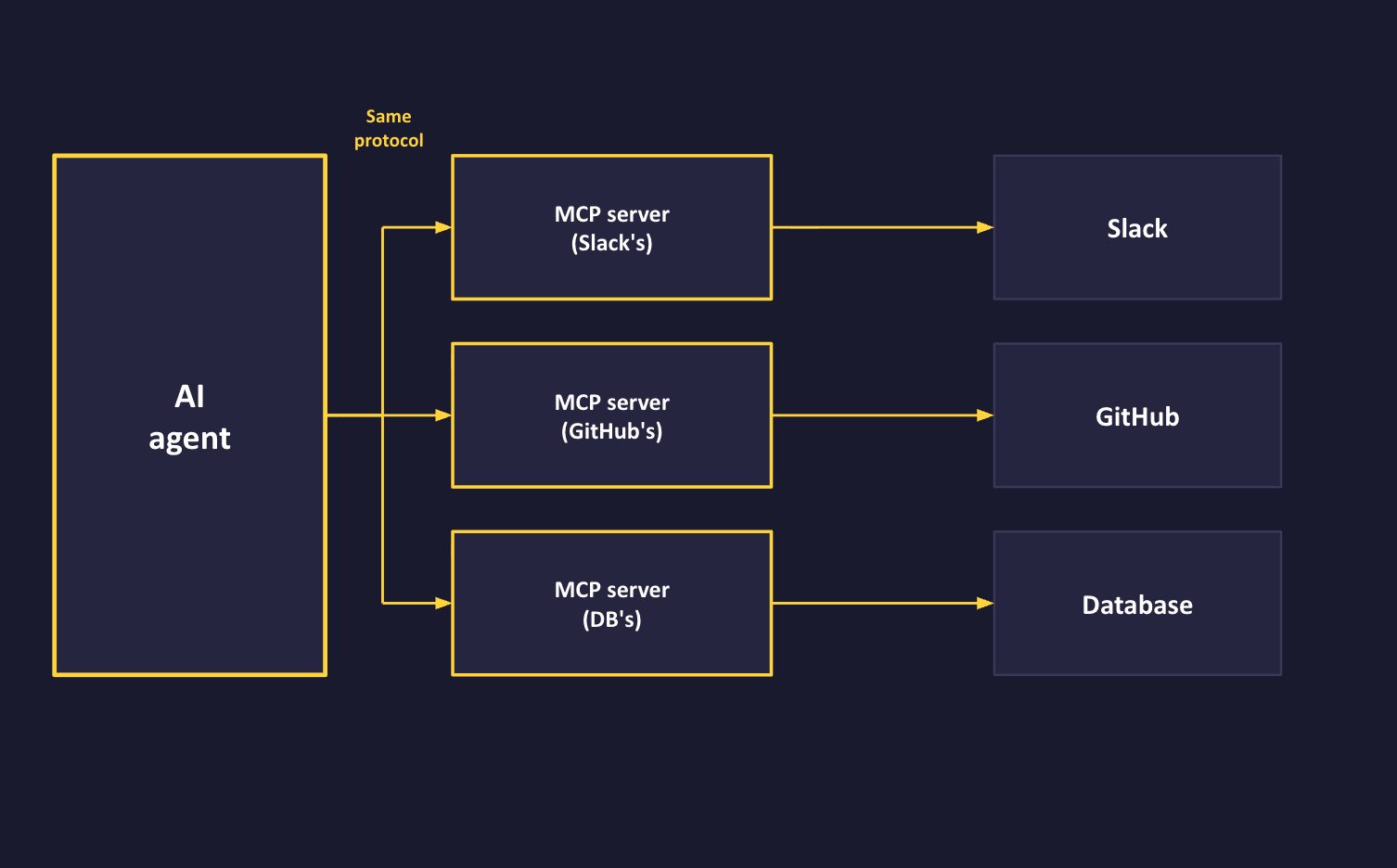
One important thing to note: each tool has its own MCP server. The AI agent connects to each one, but uses the same single protocol to talk to all of them.
🐻 Bear Tips: Want to go deeper on how MCP servers work and how to build one from scratch? Check out our guide on What is an MCP Server and How to Build One.
MCP vs. API: The Key Differences
Both MCP and APIs let different systems communicate and share data, but they are fundamentally different and solve different problems. Here are the key differences:
Purpose
APIs were designed for software-to-software communication, not specifically for AI. MCP, on the other hand, was built for AI models to access information and tools outside of their trained data.
Usage
With a traditional API, developers need to read documentation and write code for specific endpoints before they can use it because the API itself doesn't tell you what it can do. With MCP, the AI tool can query the MCP server about its capabilities directly, and it responds with a machine-readable list of capabilities (tools, resources, and prompts) that the AI understands immediately without custom code.
Statefulness
APIs are generally stateless and often require clients to re-send context (like authentication tokens and filters) with every request. MCP, in contrast, maintains stateful sessions across interactions. This makes it suitable for scenarios where ongoing context affects responses and multi-step workflows.
Abstraction layer
A traditional API is a low-level interface. It exposes raw endpoints, and your code has to know exactly which one to call, what parameters to pass, and how to parse the response. MCP sits one level higher. It wraps those raw APIs and presents them to the AI as options of capabilities with descriptions. Instead of your code explicitly calling a specific API endpoint, the AI agent reads what each tool does, figures out which one to use on its own, and interprets the result.
Do MCP and APIs Replace Each Other?
No—and this is an important thing to understand about the two.
MCP and APIs operate at different layers of the technology stack. APIs handle web communication between services and MCP sits above that layer. It wraps those APIs to make them accessible to AI agents.
Here's how they work: a data source has an API, an MCP server calls that API, and the AI agent talks to the MCP server instead of the API directly. The MCP server translates between what the AI understands and what the API expects.
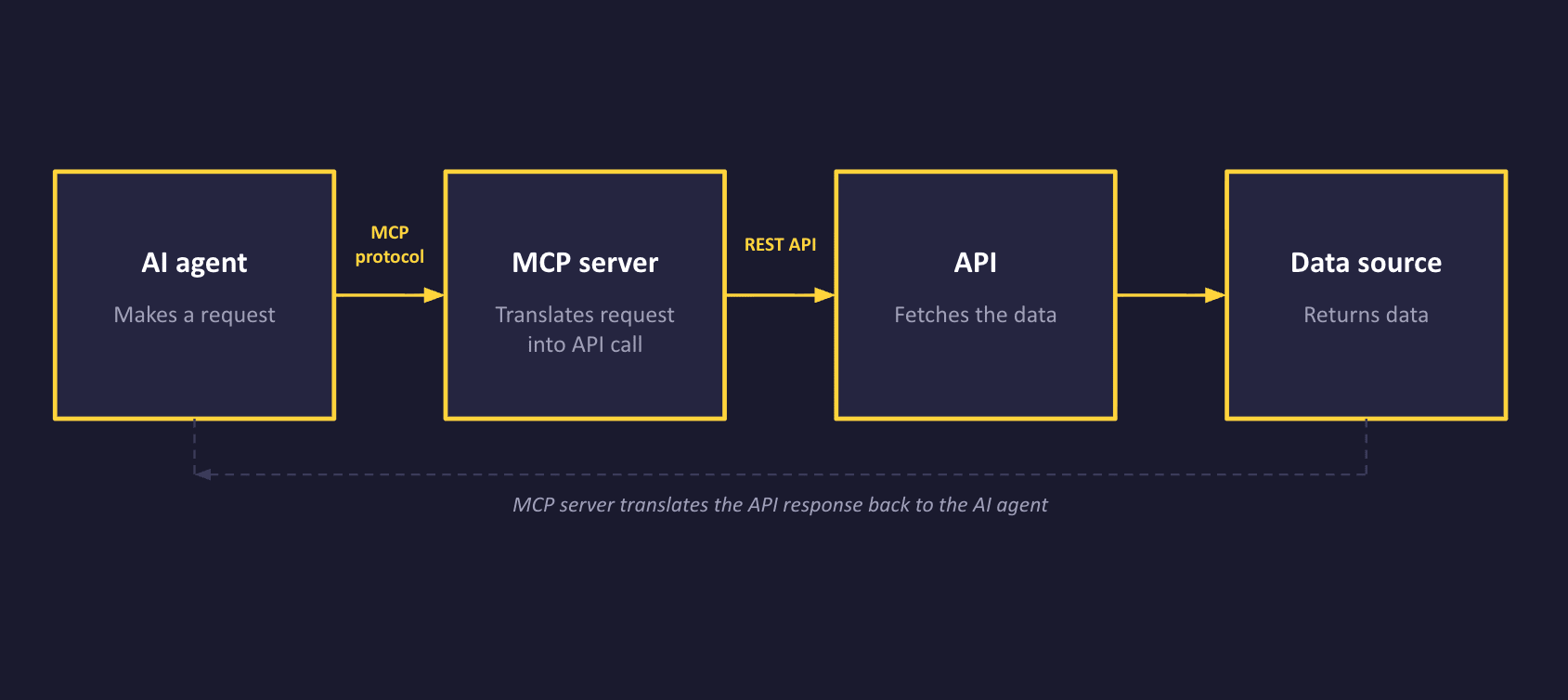
If your company already has well-built APIs, you can build an MCP server on top of them so that AI agents can discover and use those APIs intelligently.
Conclusion
API and MCP sounds similar but they are different. APIs handle the low-level data exchange, while MCP makes that data exchange accessible to AI agents without custom code for every connection.
If you're ready to start building, we've put together a list of the 8 Best MCP Servers for Claude Code Developers in 2026 to help you hit the ground running. I hope you enjoyed this article and learned something from it. See you in the next one!